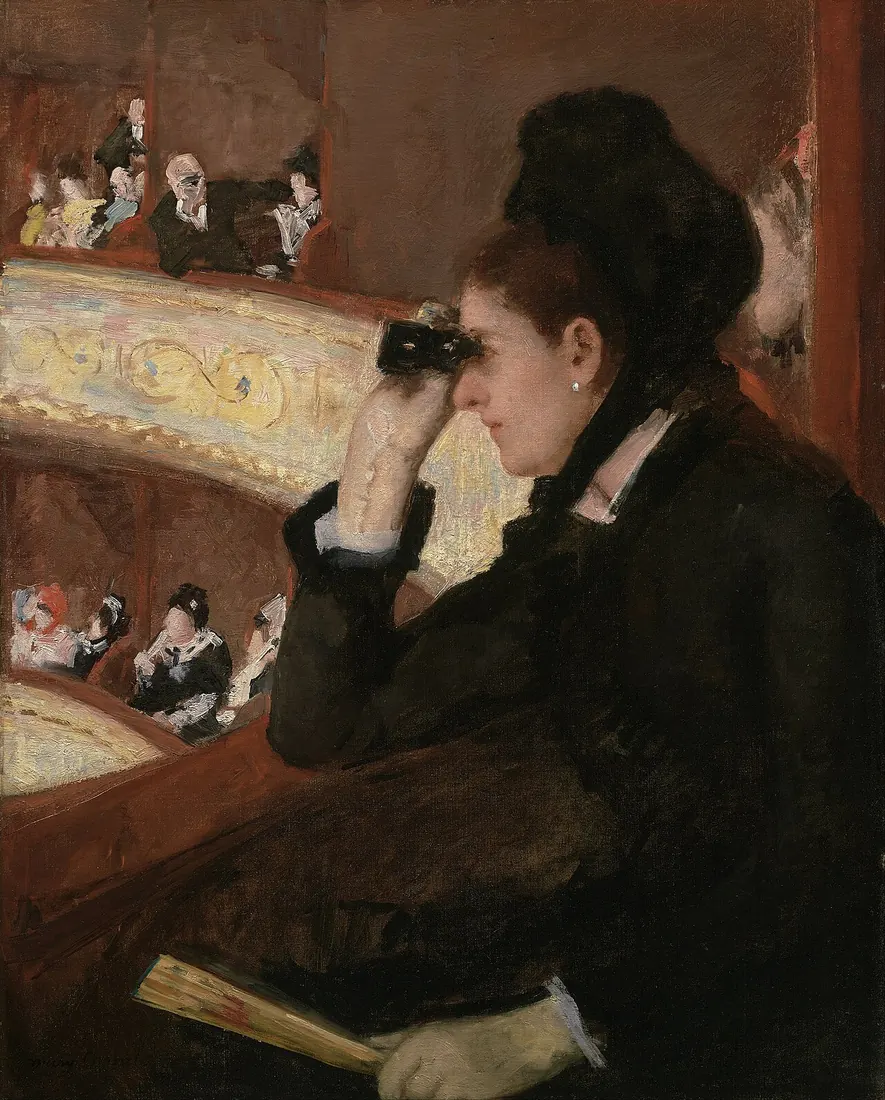
Mary Cassatt, In the Loge, 1878
About
The painting looks at you
We’re used to looking at paintings. We go to a museum, stand there, nod, read the label. Here it’s the other way round: the painting looks at you.
You enter your date of birth, and out of a large collection seven canvases step forward to meet you. Not at random. Each one speaks to a single facet of you: who you are, what you carry from your family, where you’re growing towards, how you love, how you look after yourself.
It’s an encounter. Part exhibition, part heart-to-heart, part a mirror you needn’t be afraid to look into.
It all began with my own date. There’s a Three in it: The Empress. And The Empress needs to be seen and heard: through creativity, through the stage and, above all, through the voice. I read that and went straight off to work on my voice. The voice led to the channel, the channel to the podcast, the podcast to art history, and art history all the way here. I could never have imagined how many sparks and open doors a single number could set off. A hint, not a fairy tale — and one I was lucky enough to catch. Why Three knows the way to the stage →
A number brings a person closer, like opera glasses at the theatre: suddenly you can make out every detail.
My formula is simple: the number is the essence, psychology is the path, art is the mirror. As for the meaning, as with any painting, every woman finds her own.
What’s in it for you
Be honest: when did you last really look at yourself — not a glance in the lift mirror, but properly? Not as a mother, not as an employee, not as “the one who somehow gets it all done”. Just at yourself.
A modern woman plays more roles than an actress in repertory. One in the morning, another by afternoon, a third by evening. And somewhere in between, the thing that matters most goes missing: what am I feeling right now? What do I want? Why am I worn out again, when nothing has even happened?
The trouble is, there are so many feelings we simply have no words for. “I just feel a bit off” — and that’s the whole vocabulary. And what goes unnamed keeps echoing inside, like a sentence you can never quite finish.
A painting gives you the words. You look at a woman by a window and suddenly: “Yes, that. That’s exactly how I’m living right now: looking out, and not daring to step outside.” You haven’t said a word, and yet you’ve been understood.
In art therapy this is called projection. We see ourselves in a painting because what’s inside is easier to make out on the outside. Talking about yourself is hard and awkward. Talking about the woman on the canvas is easy. And yet you’re still talking about yourself. That’s because a painting creates a safe distance: you can get close to what matters without getting your fingers burnt.
And one more thing. Nobody is marking you here. A painting doesn’t say “you should” or “there’s something wrong with you”. It simply shows. What you do with it is up to you.
That’s why the project has one key word: “Look.” Not “fix yourself”, not “work on yourself”. Look. Sometimes that alone is enough to lighten the load.
Why a painting
A painting is a moment held still. And it holds three people at once: the artist who painted it, the model who posed, and the era standing behind them both. A photograph catches a second; a painting gathers a state of mind that someone lived with for weeks while holding the brush.
One Painting: A Bar at the Folies-Bergère
All around her: champagne, lights, a crowd in the mirror, life in full swing. And at the centre, a girl behind the bar, with the look of someone who is miles away. Loneliness in the middle of a crowd. Sound familiar? A hundred and forty years have passed, and we recognise the feeling at first glance. The painting’s full story →
States of mind never date. The dresses change; the souls don’t.
Every era painted what kept it up at night
- The ImpressionistsFrance, 1870s
The world suddenly sped up: trains, newspapers, electricity. And they learned to catch the fleeting — a glint on the water, steam over a railway station. Paintings about holding on to a moment when everything is in flux. Remarkably like us, with our endless feeds.
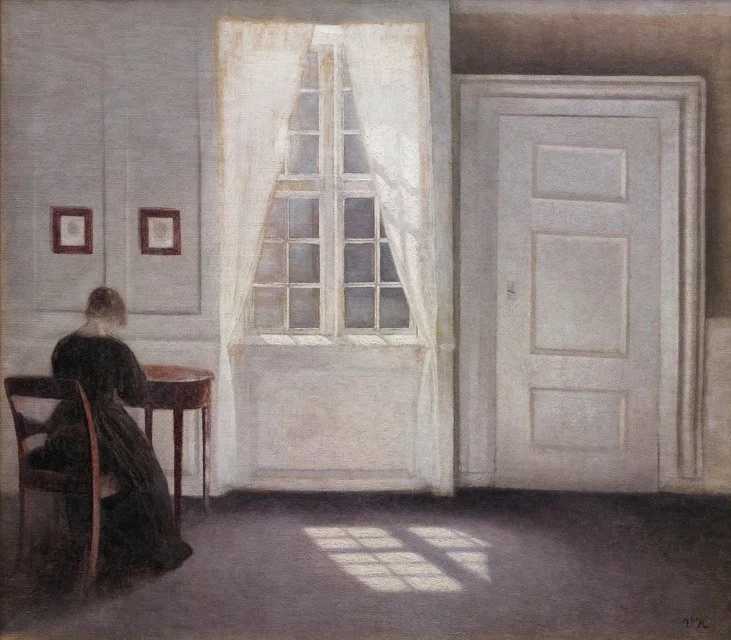
- The ScandinaviansVilhelm Hammershøi, Denmark, turn of the 20th century
Empty rooms, grey light, a woman with her back to us. No plot, no event. And yet something rises inside — the thing that happens when you’re finally alone and can hear yourself.
- The SymbolistsMunch and Vrubel, 1890s
They tried to paint the invisible. Munch’s The Scream isn’t a person screaming; it’s a scream passing through the world. Vrubel’s Demon Seated isn’t a villain but the vast melancholy of someone too big for life. They showed that what you feel inside can be seen. Which means it’s real.
That’s the quiet healing power of art. When you see your own state of mind on a museum wall, something inside unclenches: I’ve been seen already. This happened to someone before me. And it has every right to exist. You’re not strange and you’re not alone. You’re in good company — the company of great paintings.
So where does the date of birth come in?
Your date is the key to the museum door. It’s a way of choosing, out of hundreds of paintings, precisely your seven.
Look. When you walk into the Hermitage without a plan, you’re swamped. Too many halls, even more paintings, and after an hour you’re no longer looking at the art but at the signs to the exit. But if someone hands you a route of seven works, you’ll see more than you would in a whole day. Your date of birth is that route. It’s your compass.
Why a date? Because it’s the one thing in your life you didn’t choose and can’t redo. You can change your name, your city too, and we reinvent ourselves more often than we’d care to admit. But the date stays. That’s what makes it a good starting point: honest, incorruptible, yours alone.
From it, a pattern emerges in the shape of a palm. The fingers are what you brought with you: your character, your talents, the family stories on your mother’s and your father’s side. The centre of the palm is your soul mission. At the base is the point of attention: the direction not to take. The hand is no accident: with our hands we create, give, hold and let go.
All five spheres are connected, like the fingers of one hand. Personality and relationships play loudest — almost 80% of the music in us. Because we have relationships with everyone: with our mother, our husband, our children, our colleagues, even with those who are long gone. And first and foremost, with ourselves.
Now for the most important bit. A number on its own decides nothing. Remember the opera glasses in the theatre? A number brings a person closer, so you can make out every detail. What you see on the stage depends on your own eyes. A hint, not a fairy tale. You are both the pilot and the air traffic controller of your own flight.
How the journey works
Imagine a small museum built just for you. It has four halls, and you can walk through them in the time it takes to drink a cup of coffee.
Entrance. You enter your date, and in front of you is a plan of the museum in the shape of a hand. Seven points, seven paintings. You can see at a glance how far you have to go, and which way.
Hall 1. Who you are. Your character and your gift. Where your strength lies, even if you haven’t noticed it yourself.
Hall 2. Where you come from. The family script on your mother’s and your father’s side. What was handed down to you along with your grandmother’s tea set: gifts, and things left unsaid. Part of it is what your parents hadn’t yet managed to live through by the time you were born. It’s a source of strength, not a weight to carry. But what goes unlived has a habit of coming back, so it’s worth a look in here. On the channel there’s a practice for exactly this, “Bowing to Parents”.
Hall 3. What holds you. Love, money, self-care. Three pillars we tend to remember only when one of them starts to wobble. Self-care is special here: it shows how you live out your whole map.
Hall 4. Where you’re going. Your purpose and your main lesson. In the project it’s called the point of attention. That isn’t frightening; it’s honest. The point of attention is the direction you mustn’t take. Every woman has her own, and as long as you can’t see it, that’s exactly where you’re pulled. Once you’ve seen it, you can calmly choose another road.
Every painting has three layers. First, the painting itself and its story. Then “Look”: what to notice, what here is about you. And at the end, one question for yourself. Everything about numbers and the method is tucked away under “If you would like to go deeper”, for anyone curious to peek behind the scenes.
Exit. Your self-portrait. At the end, all the halls come together in four lines — a short portrait of you in words. As in a real museum, where the last hall is always the most important. You can save your map, share it with a friend and take one question with you for the week.
And then — life. The journey doesn’t end when you put your phone down. Ahead are podcasts, the stories behind paintings, art news. And one day you’ll walk into a real museum, see your painting in the flesh and think: “Oh — we’ve met.”

What you’ll leave with
Nobody leaves a good museum empty-handed. Here’s what stays with you:
- A gallery of your own
Seven paintings that are now yours. You can come back to them like old friends.
- Words
The very ones you were missing when you tried to explain to yourself (and to others) what’s going on with you.
- Your strengths
Named out loud. That’s how they become visible to you, too.
- An understanding of your family
What you took from those before you, and what you can gently put back on the shelf.
- One question for the week
Not a to-do list, but a question you can carry in your pocket and take out when you’re stuck in traffic or in a queue.
- The feeling of being seen
Perhaps the most precious of all. That warm “yes, that’s me to a T”, which stays with you longer than any text.
And one more thing, a quiet one. After a walk like this, you’ll start looking at paintings differently. Not “who painted it and what’s it worth”, but “what was this woman feeling, and why does it feel so familiar?” And from there it’s only a short step to looking at yourself just as attentively.
A painting can support you, but it can’t replace a real specialist. If things feel very hard right now, reach out to a psychologist — that’s self-care too.
Because you are art. You are a painting.
All that’s left is to look.