A reconstruction. Illustration created with AI
Art Detective · Part 2 · Summer 1945 · about 8 minutes to read, and longer to think about
Alfred Hitchcock. Summer 1945: The Truth Without Tricks
A film that sat on a shelf for 70 years, the man who could not forget it, and the memory of the war on both sides of the ocean
In Part 1 we saw how a childhood fear became the language of cinema. We are used to Hitchcock’s name meaning fear invented for pleasure. Here I want to show him from another side. Once in his life the master of invented fear met real fear. And the way he behaved says more about him as a person than all his thrillers.
And one more thing. Many of my readers think of that war as their own: their grandfathers and great-grandfathers, Victory Day. But the Second World War was also lived on the other side of the ocean: by British soldiers with film cameras, American photographers, magazine editors deciding whether to show people the truth. It is a shared memory, and it matters to see it through different people’s eyes. It is also a story about how to see a person clearly. A person shows where their tricks run out.
The film he could not forget
There will be no tricks here. Only a truth that could never have been invented.
On 15.04.1945 British troops entered the Bergen-Belsen concentration camp. A week later, on 22.04.1945, Hitchcock’s friend, the producer Sidney Bernstein, arrived there. After what he saw, he decided: there had to be a film to show the Germans themselves. The commission came from the Allied headquarters in Europe.
Chapter 1 · The people
Who called Hitchcock in
Bernstein called Hitchcock over from Hollywood as a consultant: to advise on how to build a film out of a vast archive of war footage. The Imperial War Museum describes his role as treatment adviser. Hitchcock came to London at the end of June 1945 and worked for about a month. Unpaid. The editor Peter Tanner recalled how Hitchcock watched the footage in a small screening room in Soho, and how hard it was for him.
Who shot this footage
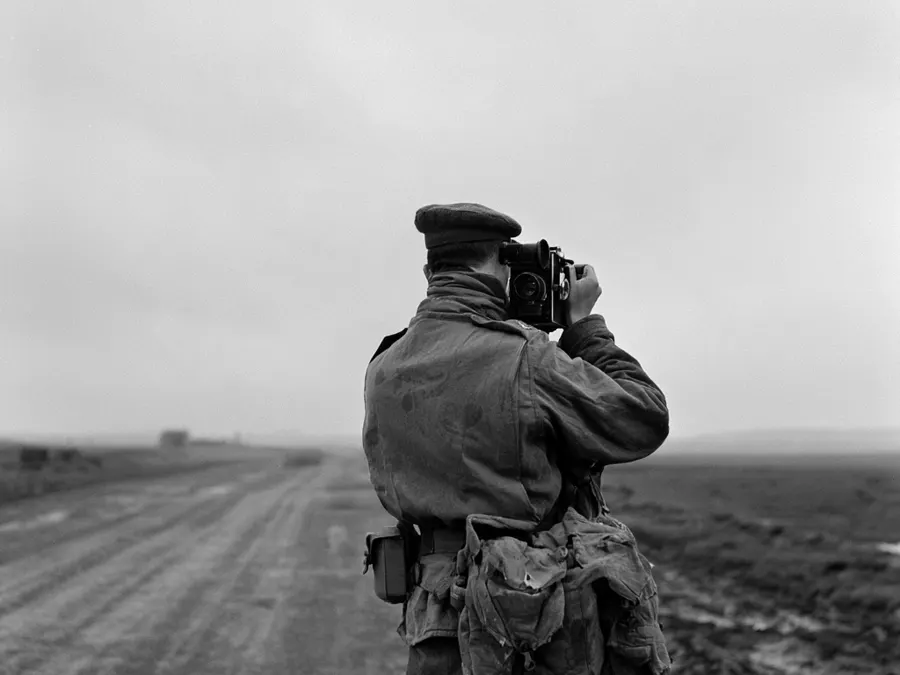
The first into Belsen, on 15.04.1945, were cameramen of the British Army Film and Photographic Unit: Sergeants Mike Lewis and Bill Lawrie with film cameras, Sergeant Harry Oakes and Lieutenant Martin Wilson with still cameras. They filmed the camp until 26.04.1945.
Their footage was shown at the trial of the Belsen guards in Lüneburg in September 1945. It was one of the first cases in history in which newsreel became evidence. An ordinary soldier with a wind-up camera became a witness for the whole world.
Chapter 2 · The film
What the film is about
The footage came from every front: British, American and Soviet army cameramen. Fourteen locations in Germany, Austria and Poland: ten camps and four sites of atrocity. Belsen, Dachau, Buchenwald, Auschwitz, Majdanek. The film opens with Nazi newsreel, parades and well-fed towns, and then the camera goes through the gates.
And it is a film about life too. In it there are children smiling at soldiers through the barbed wire. There are the people of nearby towns, brought to see what had been a few kilometres from their homes.
What Hitchcock suggested
The main advice of the master of suspense sounds unexpected: no tricks. Tanner remembered the instruction to avoid tricky editing and, as far as possible, to use long shots and pans with no cuts. Bernstein explained why: so that no one could say it was faked. The camera moves slowly from the guards to the bodies in a single movement. A cut can be disputed. An unbroken shot is hard to dispute.
He also suggested showing local residents, clergy and officials being brought into the camps. The viewer sees their faces and looks along with them.
Chapter 3 · The film’s fate
Why the film was shelved
While the work went on, the politics changed. In July 1945 the Americans left the project and made their own short film, “Death Mills”. Billy Wilder, the American director who would later make “Some Like It Hot”, supervised the work on it. The British authorities decided that an hour-long chronicle of atrocities no longer suited the new policy in Germany: the struggle for an ally in the Cold War was beginning. The last official screening of the rough cut took place on 29.09.1945, after which the film was set aside.
In 1952 five edited reels and about 100 cans of film were handed to the Imperial War Museum. There they lay for years under the number F3080 (the film’s history on the museum’s website). In 1984 a rough cut was shown at the Berlin Film Festival under the title “Memory of the Camps”, and in 1985 it was broadcast on American PBS television. In 2014 the museum restored the film and completed it from the surviving script and editing notes. Almost 70 years between the shooting and the audience.
“If the lesson of these films is not learned, night will fall.”
From the film’s narration, written by Richard Crossman and Colin Wills. The phrase gave its name to the documentary “Night Will Fall” (2014)What he said later
Hitchcock almost never spoke about this work. In the 1970s, talking to Henri Langlois, founder of the Cinémathèque française, he recalled that at the end of the war he had made a film about the reality of the concentration camps, but nobody wanted to see it then; it was unbearable. And he added a line that explains a great deal about his cinema:
I don’t think many people really want reality.
Alfred Hitchcock in conversation with Henri Langlois, 1970sWe come to him for a fear we can switch off. He knew that. And once he saw a fear that cannot be switched off.
Chapter 4 · Look
The same spring: “believe” and “look”
Hitchcock was not the only one that spring looking for a way to show the world the truth. On 07.05.1945 Life magazine printed photographs of Buchenwald by the American photographer Margaret Bourke-White and of Belsen by the British photographer George Rodger, with the caption:
Dead men will have indeed died in vain if live men refuse to look at them.
Life magazine, 07.05.1945
And the American photographer Lee Miller, war correspondent for British Vogue, sent her editor pictures from Buchenwald and Dachau with a telegram:
I implore you to believe this is true.
Lee Miller, telegram to Vogue, 1945The June 1945 issue of Vogue came out with those pictures and a single short word: “Believe”.
The magazine says “look”. The photographer says “believe”. The director removes the cuts so that no one can say “fake”. Three different people were searching for one answer: how to make the world see what it does not want to see.
Lee Miller (1907–1977) lived several lives. A model for American Vogue. Muse and pupil of the Surrealist photographer Man Ray in Paris. Then a photographer herself and war correspondent for British Vogue, one of the few women at the front.
At seven she survived sexual violence. Perhaps that is why she had so much courage to look where others were afraid to.
On 30.04.1945, the day Hitler killed himself, Lee Miller and the Life photographer David Scherman came straight from Dachau to his Munich flat. Scherman photographed her in Hitler’s bathtub, her army boots, caked with the mud of the camp, standing on his bathmat. The picture became one of the symbols of the war (see the photograph and Lee Miller’s archive).
After the war she married the artist Roland Penrose and lived at Farley Farm in England, where Picasso and Henry Moore came to stay. She struggled hard with depression and alcohol dependence: the term “post-traumatic stress” was not yet known. And, unexpectedly, she became a celebrated cook. She almost never spoke about her war. Only after her death did her son Antony find about 60,000 negatives in the attic and learn who his mother had been. And so the world rediscovered Lee Miller.
Deeper: Lee Miller’s childhood and her men A difficult subject involving childhood sexual abuse. Open it if you feel ready.
A family secret. In 1914 seven-year-old Elizabeth (she would call herself Lee later) was raped by an acquaintance of the family she was staying with in Brooklyn, and infected with gonorrhoea. Her parents believed her, but silence settled over the house. Her mother, a trained nurse, secretly gave her painful treatments for years. Her brother recalled that afterwards the girl became “wild”.
A psychiatrist’s advice. Her parents, unusually for the time, took her to a psychiatrist. According to her biographers, he advised explaining to the girl that sex was merely a physical act, unconnected with love. The aim was to lift the guilt from the child. But the advice had another side: body and feelings were split, as it were, into two separate rooms.
Her father and the camera. Soon her father, an amateur photographer, began photographing her nude, and continued until she was in her twenties. Some see this as an attempt to give his daughter back a calm relationship with her body, others as a creative collaboration. Her son Antony Penrose calls it a transgression of boundaries. The biographer Carolyn Burke believes the sessions exacerbated her childhood trauma.
How she lived with it. According to her biographer, Lee coped by pretending nothing had happened. Her men — the photographer Man Ray; the Egyptian businessman Aziz Eloui Bey, her first husband; and the artist Roland Penrose, her second — had beside them a very free, bold and ultimately elusive woman. She began affairs easily and left them just as easily.
Psychologists describe how trauma suffered in childhood, especially when it is kept silent, often goes into the body and into relationships. One way of protecting oneself is avoidance: not talking, not remembering, living as if nothing happened. Another is separating closeness from feelings: the body can be near while the soul stays at a distance. This is not a diagnosis of Lee Miller but a key that helps us understand her courage, her restless love and her silence about the war.
For me, Lee Miller’s story is about a child who was not protected and was then “treated” with silence for the rest of her life. Roots shape a great deal: how we build relationships, what we fear, what we run from. But she also shows something else: a person with such a wound was able to become a witness for the whole world. I talk about this, about her family and her men, in detail in the podcasts on my channel.
Art Historian of the SoulHer life, too, is a story of how to live after what you have seen.
I have a whole series of podcasts about Lee Miller: childhood, Man Ray, the war, Hitler’s bathtub, Farley Farm, the kitchen and the boxes in the attic. All these stories, videos and podcasts are on my Telegram channel.
And Life would come back to Hitchcock. On 01.02.1963 he appeared on its cover with three black crows, for the release of “The Birds”. He was photographed by Philippe Halsman, creator of the famous “Dalí Atomicus”.
In that 1948 picture Salvador Dalí leaps into the air while three cats, a stream of water and a chair fly around him. On a count, assistants tossed the cats and threw the water, Dalí jumped, and the furniture hung on thin wires. It was all shot in a single frame, without photomontage: it took Halsman and Dalí 28 attempts. And it was Life, too, that published it. See the photograph on the Museum of Modern Art website ›
In 1990 the psychologists Lisa McCann and Laurie Anne Pearlman described vicarious trauma: a person who looks at a great deal of other people’s suffering is changed by it, even if nothing has happened to them. Doctors, rescuers, journalists and editors of war footage know this.
The second important idea is denial, one of the psychological defence mechanisms described by the psychoanalyst Anna Freud, Sigmund Freud’s daughter, in 1936: “it didn’t happen”, “I didn’t know”, “it was staged”. A long take without cuts works against denial. It gives the eye nowhere to hide.
Chapter 5 · What came after
After Soho: how the summer of 1945 echoed in his films
He did not make a film about the camps. He began making films after the camps.
In the summer of 1945 it was no beginner who walked into that screening room. Hitchcock had been directing for twenty years, since 1925. He had lived in Hollywood since the spring of 1939, more than six years. Behind him were “Rebecca”, “Suspicion”, “Shadow of a Doubt”, “Lifeboat”, and “Spellbound” was about to be released. A master at the height of his powers, reproached at home for sitting out the war in America. And for a month, unpaid, this master watched the most terrible footage the war had produced.
Was there a breakdown?
There is no documentary evidence of a nervous breakdown. There is a story the press is fond of: that after the screening he stayed away from Pinewood Studios for a week. But it is a retelling, and I could not find its original source, so I treat it with caution. What is reliable is this. We already know from the editor Peter Tanner that Hitchcock was horrified by the material and forced himself to watch it. And in October 1945 he was already shooting “Notorious”. He did not break down and he did not stop. He went back to work and carried what he had seen with him: thirty years later he would say that film had stayed in his mind all along.
A body that takes the blow
Hitchcock’s body always answered loss before words did. In September 1942 his mother died; in January 1943 his elder brother William died suddenly. After that he went on a strict diet and, by his own account, lost about 100 pounds, roughly 45 kilograms. He even turned that into a joke: his cameo in “Lifeboat” is a newspaper advert for an invented slimming product, “Reduco”, with “before” and “after” photos. I found no reliable figures for his weight after 1945, so I won’t guess.
But the reaction itself is understandable. When the world slips out of control, a person takes control of what they can: the plate, the routine, their own frame.
What changed in the films
“Notorious” (1946). Nazis who fled to Brazil, and uranium in wine bottles. The war is over, but the evil has not gone anywhere. It sits at the next table, in a good suit, with a glass in its hand.
“Rope” (1948). The first picture Hitchcock produced together with that same Sidney Bernstein. It is based on Patrick Hamilton’s 1929 play and a real 1924 case: two students killed a boy to prove their superiority. The film’s heroes see themselves as Nietzschean “supermen”, entitled to decide who deserves to live. Three years after the camps the idea sounds anything but abstract. The action unfolds in real time, and the film looks like a few very long takes, up to ten minutes without a visible cut.
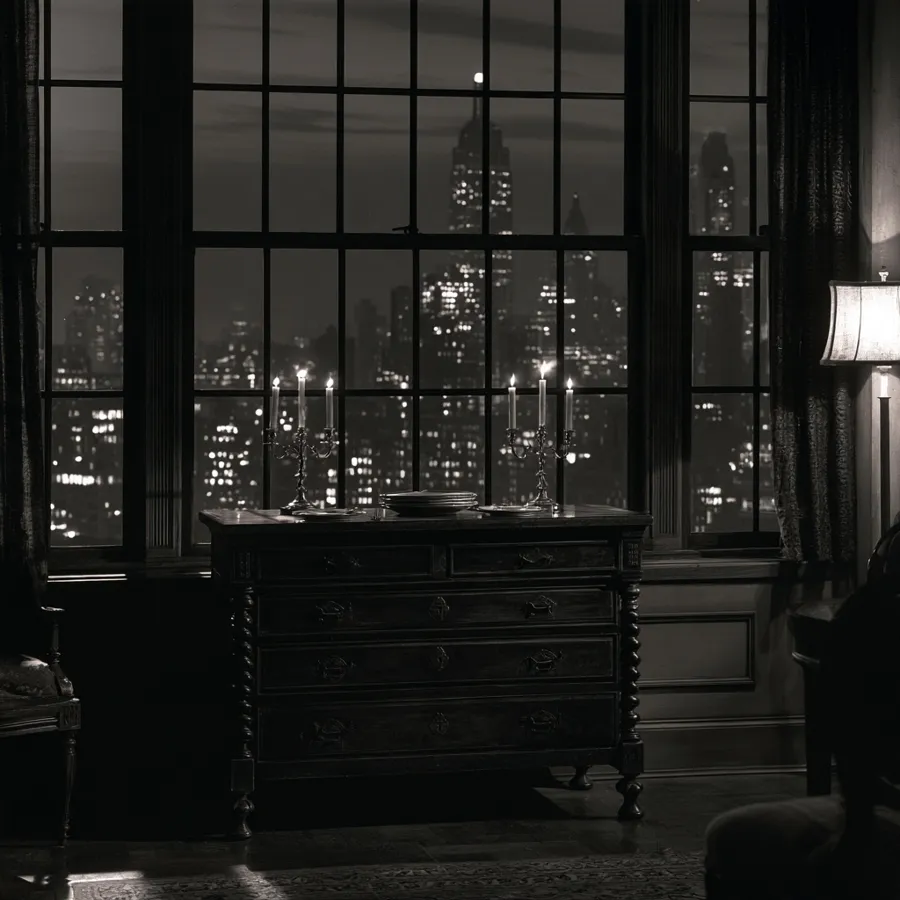
Film scholars link his interest in the long take to the camp film. It is an interpretation, not an established fact, but the coincidence is too eloquent to ignore.
How he spoke to the audience
His main device is known from his interviews with François Truffaut: show the audience a bomb under the table, and an ordinary conversation at that table becomes unbearable. The viewer knows more than the hero and so becomes an accomplice. Talking to Langlois he explained the other side: reality in cinema must only look real, because no one can stand the real thing for long.
That is his genius. He knew the dose precisely. In fiction he gave fear drop by drop, through anticipation. In the camp film he forbade himself any dosage at all. A master is not the one who commands a device, but the one who knows when a device would be a betrayal.
In 1996 the psychologists Richard Tedeschi and Lawrence Calhoun described post-traumatic growth: after a hard experience a person can not only suffer but also change in depth. They begin to see their values, relationships and work differently. The hard thing does not disappear, but it becomes part of their character and of what they do.
With Hitchcock this shows not in words (he hardly spoke of it) but in his films: distrust of “supermen”, attention to those who “knew nothing”, evil hiding behind good manners.
9 The Hermit. This is his scale. The Hermit lives through the most important things alone and in silence. Hitchcock hardly spoke about that summer, but he carried it through his whole life.
12 Reversed view. Seeing an event from the other side. That is exactly what he proposed: a map around the camp and the faces of neighbours who lived a few kilometres away.
6 The body. His health. Loss echoed first in his body, and only later in his frames.
The author’s interpretation by my method, not a scientific fact.- In the summer of 1945 Hitchcock worked unpaid for a month on a film about the Nazi camps and watched the footage again and again.
- His main advice was unexpected for a master of suspense: no tricks, only long takes.
- Because of politics the film sat on a shelf for almost 70 years and reached audiences only in 2014.
- That spring Lee Miller, Life magazine and Hitchcock were solving the same problem: how to make the world see what it does not want to see.
- There was no breakdown: he went back to work, and what he had seen went into his films, from “Notorious” to “Rope”.
Finale
Why this is the key to him
Character shows where the tricks run out.
We remember Hitchcock for the bomb under the table, the shower in “Psycho”, the birds. All of these are devices. But character shows where the devices end. In the summer of 1945 he could have shown off his skill. He showed something else: respect for a truth that needs no director.
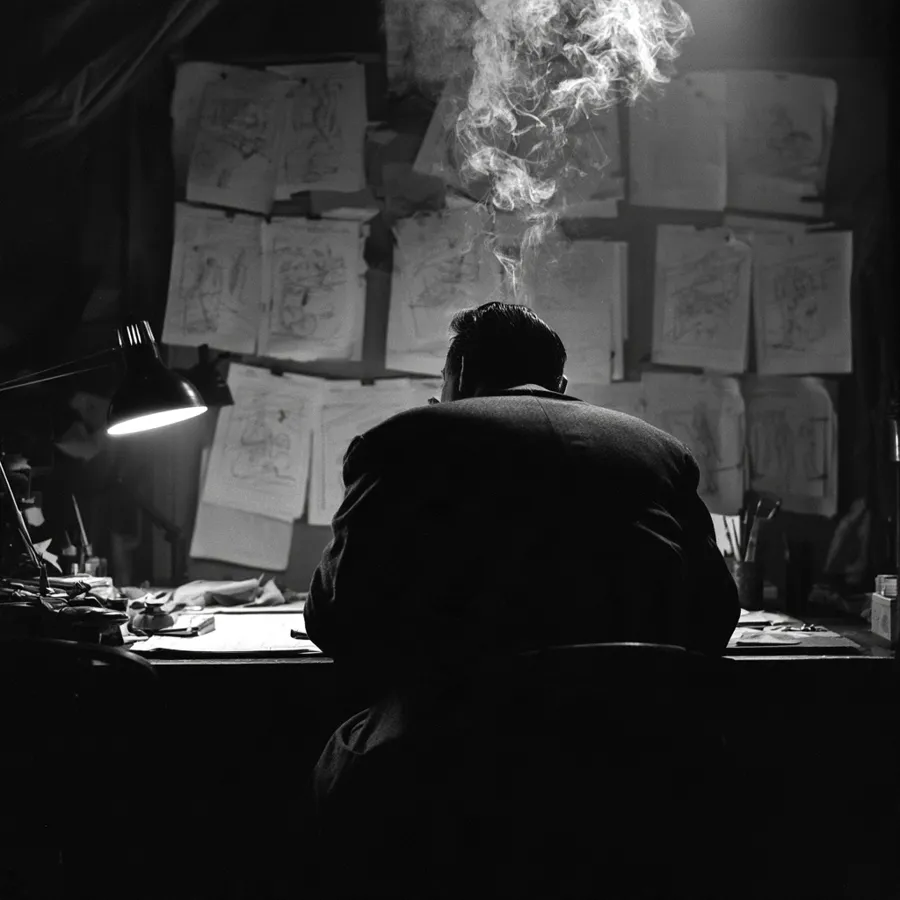
The man. A boy locked up without explanation grew into a man who kept everything under control: the frame, the routine, the plate, people. Control was his defence against fear and his main tool.
The body. He turned his shame about his weight into a sign: his silhouette became a logo.
Relationships. With the world, distance. With his actresses, admiration and a desire to control that, according to Tippi Hedren, crossed the line. And one person he trusted completely: Alma. Their union was change and balance, where her invisible work held up his scale.
Profession. Perfectionism, calculation and a bet on himself. He knew exactly how much fear to give the audience, and knew when tricks had to be dropped altogether, as in the summer of 1945.
The main thing: the fear did not vanish. It became material.
1 The storyboard. He saw the whole film before shooting began. You can “storyboard” an important task too: write out the steps on paper, and the anxiety will shrink.
2 The bomb under the table. An audience grows tense when it knows more than the hero. In life it is the other way round: in an important conversation, say the main thing first, and the tension will go.
3 The MacGuffin. Hitchcock’s name for the object everyone chases, though it does not matter in itself. Ask yourself: which MacGuffin am I running after?
4 The long take. When it comes to the truth, drop the effects and the cuts. Honesty is stronger than any trick.
5 The cameo. He appeared in every one of his films. Appear in your own life too: don’t hide behind the frame.
6 The first viewer. He had Alma. Find someone you can show a draft to and hear the truth.
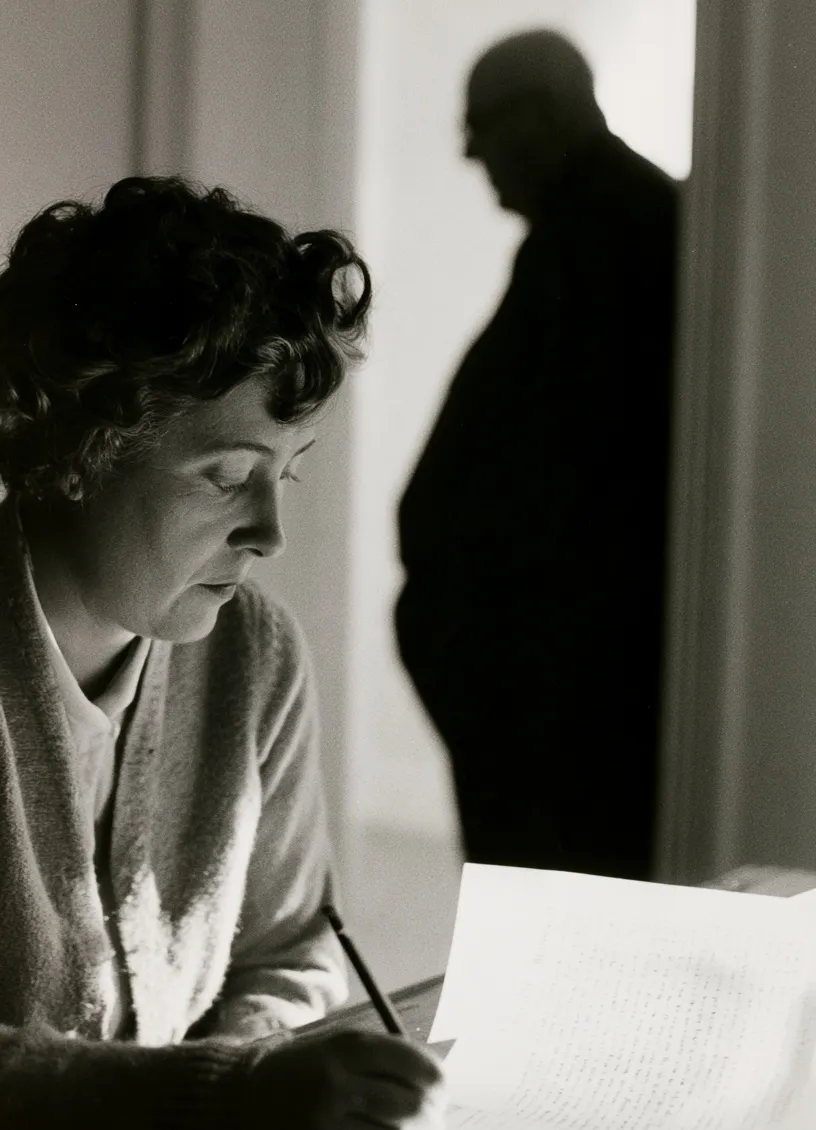
What to watch
Five cult films: what to watch after this story
Two young men murder a fellow student and host a dinner party beside the chest where the body is hidden.
Look at: the long takes without visible cuts, and how the idea of the “superman” hides behind polite conversation.
A photographer with a broken leg (James Stewart) watches his neighbours out of boredom and comes to suspect a murder. At his side, Grace Kelly.
Look at: we watch with the hero and become accomplices in his spying.
The musician Manny Balestrero (Henry Fonda) is mistaken for a robber. A true story, and Hitchcock himself, in silhouette, warns the audience that every word of it is true.
Look at: how a mistake by the system destroys a family. The hero’s wife (Vera Miles) breaks under the strain.
A retired detective who is afraid of heights (James Stewart) falls in love with the woman he is following (Kim Novak). A box-office failure, then almost unavailable to audiences for two decades, and in 2012 the greatest film of all time in the Sight & Sound critics’ poll.
Look at: how the hero remakes a living woman into an image. This is that same “male gaze” from Part 1.
A documentary by André Singer (BFI article on the film) about how the liberation of the camps was filmed and why the 1945 film lay on the shelf for almost 70 years.
Please note: the film contains harrowing newsreel footage. Watch it only if you feel strong enough.
Why did the greatest master of suspense never win his Oscar? I have my own theory. More details and analyses in my Telegram channel. Subscribe.
Enjoyed it? Share it with someone who loves cinema. More stories, podcasts and readings are in my Telegram channel.
Sources. Imperial War Museums, «German Concentration Camps Factual Survey: history», iwm.org.uk.
BFI, “Night Will Fall: the story of file number F3080” (recollections of Peter Tanner, Hitchcock’s conversation with Henri Langlois).
Berlinale Forum 2014, materials for the screening of the restored version.
Wikipedia, «German Concentration Camps Factual Survey»; «Sidney Bernstein, Baron Bernstein»; «Transatlantic Pictures».
belsen.co.uk, «Sgt. Mike Lewis (AFPU)»; Sydney Jewish Museum, «Liberators and the Liberated» (Google Arts & Culture); IWM, «Belsen: What They Found»; IWM, «Lee Miller’s Second World War».
Burke C. Lee Miller: A Life, 2005 (and the author’s interview, Penguin Random House); Britannica, “Lee Miller”; MoMA, “Philippe Halsman. Dali Atomicus” (28 attempts); TIME, “Dalí Atomicus”; CNN Style, “Lee Miller archives”; Thames & Hudson, “The endlessly adventurous life of Lee Miller”; Penrose A. The Lives of Lee Miller, 1985; National WWII Museum, “Lee Miller: Witness to the Concentration Camps”; Smithsonian Magazine, 27.09.2024, on Lee Miller.
PBS, “Reporting America at War”, timeline, 11.04.1945 (Life caption, 07.05.1945); Princeton University Art Museum, Life spread “Atrocities”.
Merriam-Webster, «Hitchcockian».
TV Guide, Hitchcock biography (Life cover, 01.02.1963); University of Missouri–St. Louis, inventory of the 1963 Life collection; Magnum Photos, “Philippe Halsman: making Hitchcockian portraits”.
McCann I. L., Pearlman L. A. Vicarious traumatization. Journal of Traumatic Stress, 1990.
Freud A. Das Ich und die Abwehrmechanismen, 1936.
Tedeschi R. G., Calhoun L. G. The Posttraumatic Growth Inventory. Journal of Traumatic Stress, 1996.
McGilligan P. Alfred Hitchcock: A Life in Darkness and Light, 2003; Spoto D. The Dark Side of Genius, 1983 (via The Alfred Hitchcock Wiki chronology: 1943, 1945).
Hitchcock A. “The Role I Liked Best…”, on the “Lifeboat” cameo; PBS Frontline, “Memory of the Camps”.
“Rope” (1948): American Society of Cinematographers, “Alfred Hitchcock’s Rope — Something Different”.
Mental Floss, “When Hitchcock Banned Audiences From Seeing His Movies” (“Vertigo” out of circulation); Wikipedia, “What They Found” (Sam Mendes’s film, 2025).